
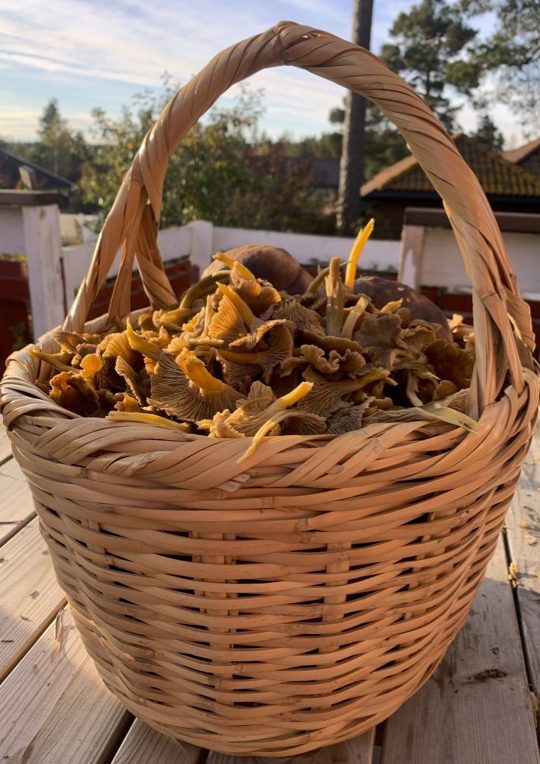
Last Sunday, under an overcast Norwegian sky, we laced up our boots, grabbed our baskets, and set off into the forest surrounding my in-laws’ home in Våler. The mission: to find chanterelles — Norway’s “gold of the forest.”
It was the perfect day for mushroom hunting, not yet cold enough for my wooly norwegian socks, and the sun still warming us up under the overcast sky. The air was thick with that earthy, mossy scent unique to early autumn, and the squelching underfoot a reminder of autumns onset. Spirits were high as we wandered into the quiet woodland armed with optimism and Hans’s mum — our resident mushroom controller.
Slow start and the Golden Call
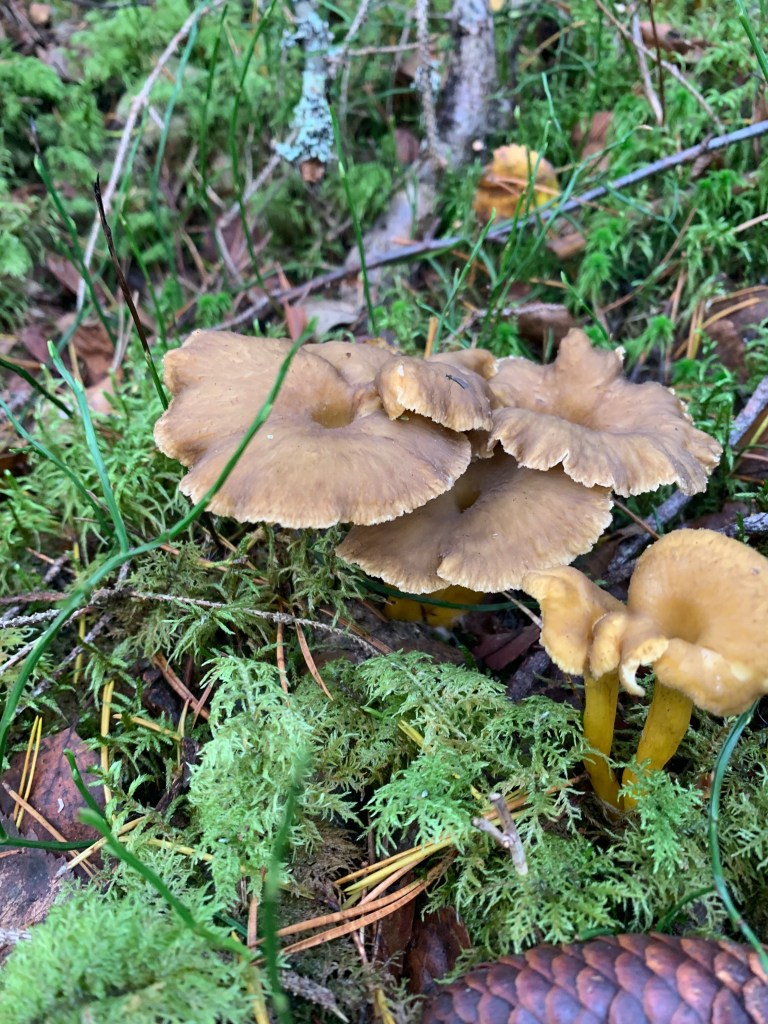
We began our search by fanning out between the spruce and birch. Several silent minutes passed. With only moss, pinecones, and a few hopeful false alarms. The forest floor was a patchwork of brown and gold, the fallen autumn leaves doing their best to camouflage the treasure we sought.
Just as I began to think our baskets would remain empty, a distant call echoed through the trees:
“Kantareller!” Jackpot!
Weaving between the trunks and moss-covered mounds, there they were. A glowing patch of chanterelles, their ruffled edges peeking shyly through the leaf litter. From that moment, everything changed. Once your eyes adjusted to spotting the right shade, you couldn’t unsee it. The forest came alive — chanterelles here, there, and seemingly everywhere. So much so that we had to take a coffee break.
A surprise among the roots
And then came my proudest moment. Wandering a little off the main trail, I stumbled upon an entire cluster of red-and-white mushrooms — the classic fairy-tale variety whose name escaped me in the excitement (Amanita muscaria, as I later confirmed — beautiful but decidedly not dinner material).
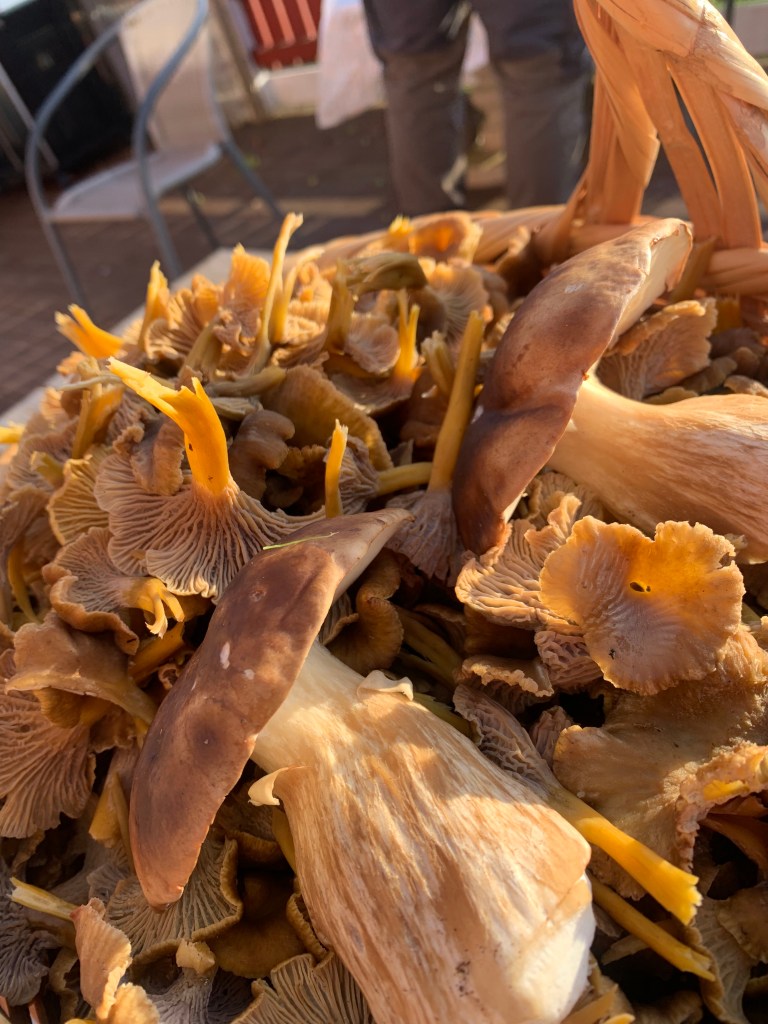
A few metres further on, near the base of a tree root, sitting regally among the moss, was the most textbook porcini I have ever seen. Perfectly round, a warm chestnut cap with a pale, sturdy stem — it looked for all the world like a freshly baked bread roll left to cool by nature herself.
Forest bathing: more than a walk in the woods
Of course, the treasure hunt was only part of the reward. A growing body of research shows that time spent in forests has measurable effects on our physical and mental health — a concept known as forest bathing (shinrin-yoku in Japanese).
Studies have found that forest environments can:
- Lower stress levels, heart rate, and blood pressure (Kaiser Permanente, 2023).
- Improve mood and reduce fatigue, anxiety, and confusion (Antonelli et al., Int. J. Environ. Res. Public Health, 2022).
- Boost immune function by increasing the activity of natural killer (NK) cells — possibly thanks to phytoncides, natural compounds released by trees (Li et al., Environ. Health Prev. Med., 2016).
- Enhance focus and mental clarity by reducing “directed-attention fatigue” (Harvard Health Publishing, 2020).
In other words, every time we paused to admire a patch of moss or listened to the wind through the pines, we were doing our minds and bodies a world of good.
Mushrooms of Våler: Seasonal Gems
Eastern Norway’s forests are generous in late summer and autumn. Chanterelles (Cantharellus cibarius) thrive in moist soil under conifers and mixed woodland, often appearing after rain (and there has been plenty this year). Their golden hue can be tricky to spot under fallen leaves — as we learned the hard way!
Porcini (Boletus edulis) love similar habitats and tend to appear from mid-summer through autumn, depending on rainfall and temperature. And as the season progresses, the funnel chanterelle (Craterellus tubaeformis) begins to appear, extending the foraging season well into November.
A quick word of caution: while chanterelles and porcini are prized delicacies, many lookalikes are not. Always verify your finds.
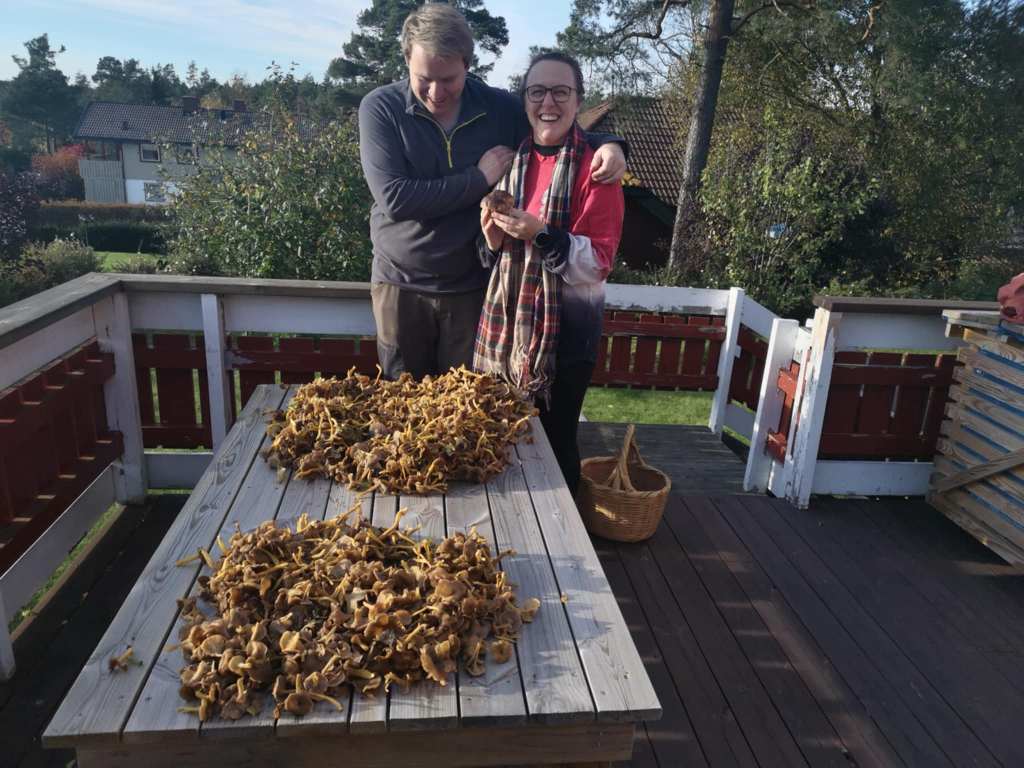
Home again!
After a few hours in the forest, we returned with full baskets and muddy boots. The work wasn’t over — now came the sorting, trimming, and brushing. There’s something almost meditative about cleaning mushrooms, and the garden filled with laughter as we compared our finds and teased each other over who had discovered the best patch.
Curiously Facts About Foraging in Norway
1. Allemannsretten — “The Right to Roam”
One of the joys of living (and foraging) in Norway is allemannsretten — the ancient “right to roam.” This gives everyone the legal right to explore, hike, and pick wild berries, herbs, and mushrooms in uncultivated areas, as long as you show respect for nature and private land. In short: take only memories (and mushrooms), leave no trace.
2. Norway’s love affair with mushrooms
Norwegians have been foraging for generations, and mushroom-picking (sopptur) is almost a national pastime come autumn. Many municipalities even have local mushroom associations (soppkontroll) where experts check your haul for safety — a service still widely used today.
3. A climate made for fungi
Norway’s combination of cool nights, humid air, and mossy soil creates perfect conditions for mushrooms. The season typically runs from late July to October, but in milder years, yellowfoot mushrooms can be found right through November.
4. Foraging is good for body and soul
It’s not just about food — studies link foraging with lower stress levels, improved mindfulness, and greater connection to nature (Soga & Gaston, Ecological Applications, 2016). Plus, crouching, walking, and carrying your basket gives you a sneaky full-body workout!
Curious thoughts and tips for fellow foragers
- Patience pays off. The first find always takes the longest — after that, your eyes seem to adjust to “mushroom vision.”
- Don’t rush. Slow, mindful movement not only helps you spot more, it helps you soak in the calm.
- Respect the forest. Leave some mushrooms behind to let the spores spread.
- Learn as you go. Photograph unknown species, join local foraging groups, or use an identification app — but always double-check before eating.
There’s something magical about foraging — the blend of discovery, connection, and gratitude that comes from gathering food with your own hands. And when it’s shared with family, under a soft Norwegian sky, it becomes a memory that warms even the rainiest autumn day.
References
Forest Bathing and Mental Health Benefits:
- Antonelli, M., Barbieri, G., & Donelli, D. (2022). Effects of forest bathing (shinrin-yoku) on levels of cortisol as a stress biomarker: A systematic review and meta-analysis. International Journal of Environmental Research and Public Health, 19(11), 7063. https://doi.org/10.3390/ijerph19117063
- Kaiser Permanente (2023). What is forest bathing? Kaiser Permanente Health and Wellness. Retrieved from https://healthy.kaiserpermanente.org/
- Li, Q., Kobayashi, M., Inagaki, H., Hirata, Y., Li, Y. J., Hirata, K., … & Kawada, T. (2016). Effects of forest bathing on physiological and psychological responses in young Japanese male subjects. Environmental Health and Preventive Medicine, 21(1), 18–26. https://doi.org/10.1007/s12199-014-0424-7
- Harvard Health Publishing. (2020, May 29). Can forest therapy enhance health and well-being? Harvard Medical School. Retrieved from https://www.health.harvard.edu/blog/can-forest-therapy-enhance-health-and-well-being-2020052919948
Foraging and Nature Connection Benefits:
- Soga, M., & Gaston, K. J. (2016). Extending the biophilia hypothesis: Do experiences with nature promote positive human–nature relationships? Ecological Applications, 26(8), 2702–2712. https://doi.org/10.1002/eap.1371
General Norwegian Foraging Information (background sources):
- Visit Norway. (2023). Eastern Norway — a paradise for mushroom and berry pickers. Retrieved from https://www.visitnorway.com/
- Norwegian Association for Mycology and Foraging (Norsk Sopp- og Nyttevekstforbund). (n.d.). Soppkontroll – mushroom inspection services. Retrieved from https://soppognyttevekster.no/
- Universitas. (2023). Picking mushrooms like a pro. Retrieved from https://www.universitas.no/picking-mushrooms-like-a-pro/


 Curiously AligneD
Leave a comment