

If you’ve ever been to a chiropractor (or watched one of those oddly satisfying adjustment videos online), you might have wondered: what’s really going on when a chiropractor makes that quick movement and you sometimes hear a little “pop”?

Lets break it down
Photo by Yan Krukau on Pexels.com
A chiropractic adjustment—also known as spinal manipulation—is a precise, controlled movement applied to a joint, most often in the spine, although we do manipulations on other joints in the body as well.
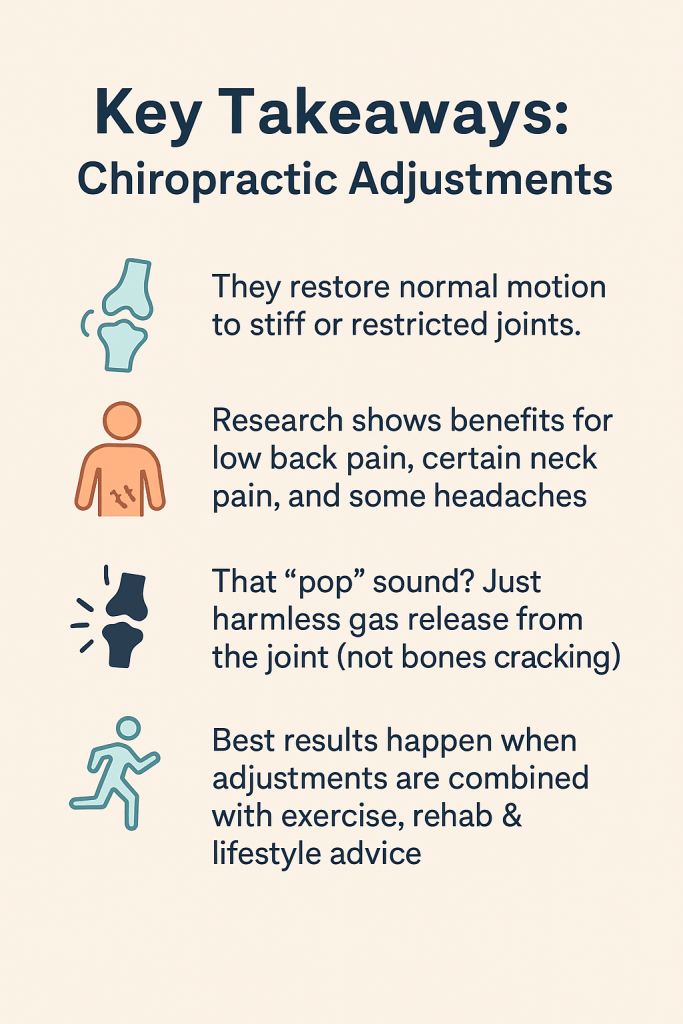
The goal isn’t about “cracking bones” (your spine is very much intact, don’t worry!) but rather restoring motion to joints that have become a little stiff or restricted.

That small change can help reduce irritation in the surrounding muscles and nerves, giving your body a better environment to move, function, and heal.
Why Adjustments Matter
When joints don’t move well, your body often lets you know. Sometimes that looks like pain, sometimes stiffness, and sometimes even discomfort and referred pain in surrounding areas.
Research shows that spinal manipulation can be effective for:
- Low back pain – especially acute or subacute episodes [Paige et al., 2017, Annals of Internal Medicine].
- Certain types of neck pain [Gross et al., 2015, Cochrane Review].
- Some headaches such as cervicogenic (neck-related) headaches [Biondi, 2005, Current Pain and Headache Reports].
While an adjustment isn’t a magic wand, it can be a valuable tool for pain management and improving mobility.
How It Helps With Injuries & Recovery
Think of an adjustment as giving a joint a little “reset.” By restoring proper motion and reducing muscle tension, the body is often better able to:
- Move with less restriction
- Recover more comfortably after an injury
- Work in harmony with other treatments, like exercise therapy and rehabilitation
This is why, at the clinic, I rarely use chiropractic adjustments in isolation. I have found they are most effective as part of a bigger care plan that may also include mobility work, strengthening, and lifestyle advice tailored to your needs.
A Note on the “Pop”
That sound you sometimes hear during an adjustment? It’s not bones cracking (promise!). It’s a harmless release of gas from the fluid in your joints—a bit like opening a fizzy drink can.
Satisfying, but not the main event.
The Bottom Line
Chiropractic adjustments are safe, controlled, and evidence-based techniques designed to help your joints move better, reduce irritation, and support your body’s natural healing.
And while the adjustment often gets all the spotlight, it’s just one piece of a well-rounded approach to helping you move better and feel better.
References
- Paige NM, Miake-Lye IM, Booth MS, et al. Association of Spinal Manipulative Therapy With Clinical Benefit and Harm for Acute Low Back Pain. Ann Intern Med. 2017;166(7):463–473.
- Gross A, et al. Manipulation and mobilisation for neck pain contrasted against an inactive control or another active treatment. Cochrane Database Syst Rev. 2015;(9):CD004249.
- Biondi DM. Cervicogenic headache: Diagnostic evaluation and treatment strategies. Curr Pain Headache Rep. 2005;9(5):384–391.


 Curiously AligneD
Leave a comment